
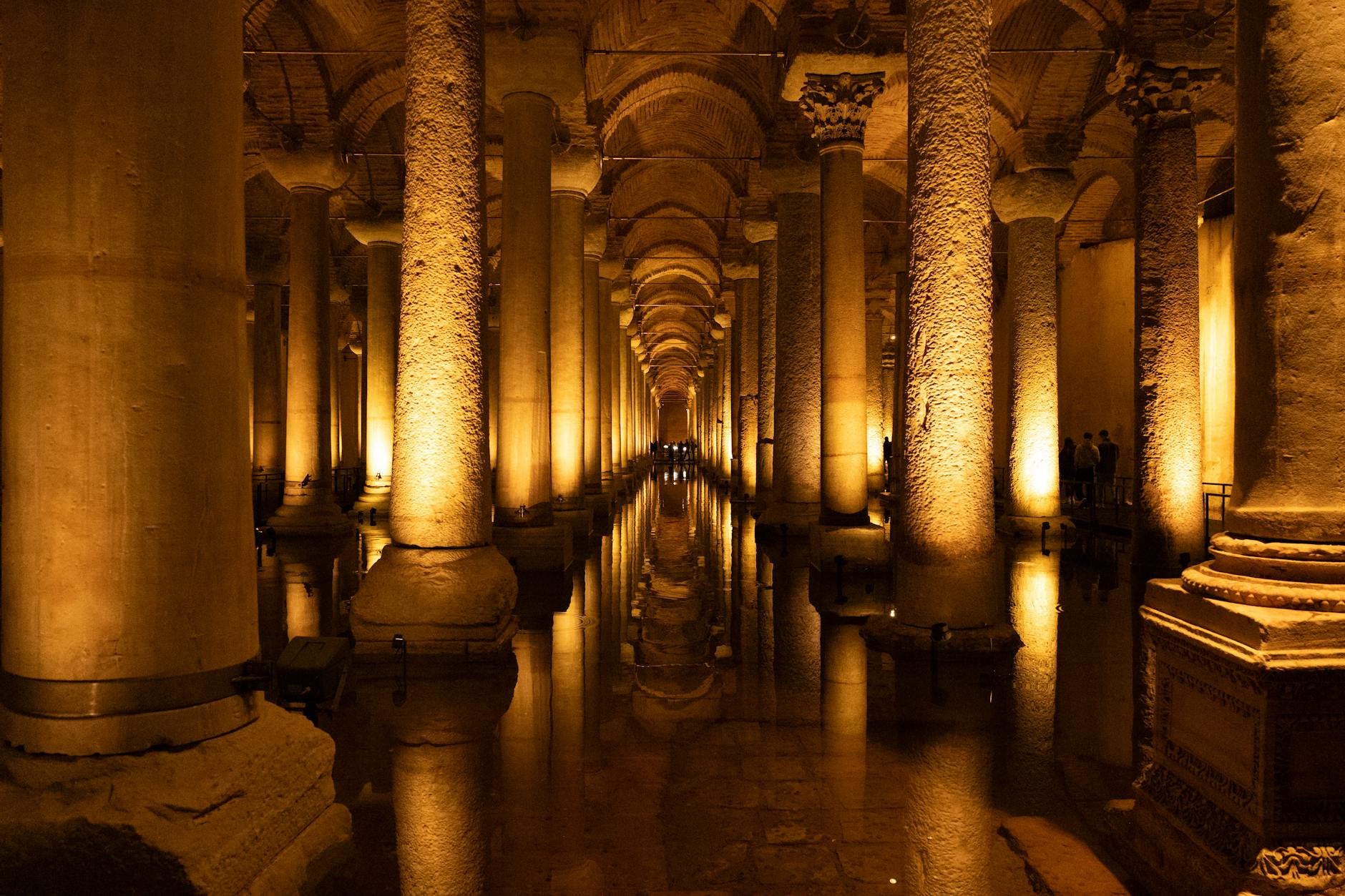
Standing in the long shadow of the Hagia Sophia, I often find myself pausing to watch the queue for the Basilica Cistern. It snakes around the block like a weary, sun-baked dragon, tourists shielding their eyes and checking their watches with that familiar “vacation fatigue.” After fifteen years of calling this city home, I’ve learned when to join the crowd and when to quietly slip away from it. Every time I see that line, I just smile, keep walking for ten minutes through the backstreets of Sultanahmet, and step into a modest glass pavilion that most people walk right past.
Inside, the city’s roar—the honking yellow taxis, the shouting simit vendors, the chatter of thousands—evaporates instantly. I descend the stairs, and suddenly, 1,600 years of history is breathing against my skin. This is the Theodosius Cistern, known locally as Şerefiye Sarnıcı, and it is, hands down, my favorite sanctuary in the city.
While its more famous cousin, the Basilica, is undoubtedly grand, there is a frantic energy there that makes it hard to truly feel the weight of the Byzantine past. The Theodosius, however, offers something a discerning traveler craves: stillness. It’s one of those rare Istanbul hidden gems where you can actually hear your own footsteps echoing off the marble columns. The air is cool and damp, smelling faintly of ancient stone and deep earth, providing a sensory reset from the midday heat above.
What makes this place truly special for me isn’t just the lack of elbows or the absence of a two-hour wait. It is the way the city has married its staggering antiquity with a modern, artistic soul. Here, the columns don’t just hold up the ceiling; they act as a canvas for a story that is being retold through breathtaking light and sound.
If you’re looking to peel back the layers of the city without the tourist-trail stress, you’ve come to the right place. Let’s dive into why this subterranean marvel is the secret highlight of any proper Istanbul itinerary, and how you can experience its magic before the rest of the world catches on.
A Breath of Cool Air: My First Encounter with Serefiye Sarnıcı
Believe me, I love the energy of Sultanahmet as much as anyone. I’ve lived here for fifteen years now, and I still get a thrill from the scent of roasted chestnuts and the rhythmic clanging of the T1 tram. But let’s be honest: by 2026, the heart of the Old City can feel a bit like a pressure cooker. On a typical Tuesday afternoon, you’re dodging selfie sticks at the Hagia Sophia and navigating a sea of tour groups near the Basilica Cistern. It’s vibrant, yes, but it’s exhausting.
That’s why, whenever a friend visits me here, I lead them away from the long queues and toward a relatively quiet corner near the old municipal building. I want to show them one of my favorite Istanbul hidden gems: the Şerefiye Sarnıcı, or the Theodosius Cistern.
Stepping Out of the Sultanahmet Swirl
I still vividly remember my first encounter with this place shortly after the massive restoration was completed back in 2018. Before then, the cistern was literally hidden under an ugly 1950s department headship building. When they tore the old concrete away, they revealed a masterpiece of Byzantine architecture that had been holding up the city in silence for 1,600 years.
As you walk toward the entrance today, the contrast is startling. One moment you are in the sun-drenched chaos of the street, and the next, you are standing before a minimalist, shimmering glass pavilion. It looks like a modern art gallery, but it’s actually a portal.
When you step through those glass doors, the city noise—the shouting vendors, the honking taxis, the sheer weight of 20 million people—simply vanishes. It is replaced by a heavy, reverent silence. As we navigate 2026’s economy, where the Euro sits at 50 TL and the Dollar at 45 TL, finding a world-class historical site that offers this level of tranquility without the three-hour wait is a rare luxury.
A Modern Portal to an Ancient World
The descent is my favorite part. As you move down the stairs, you can feel the temperature drop by ten degrees. The air becomes heavy and cool, carrying that specific, earthy scent of ancient stone and stagnant water—what I call the “scent of history.”
To help you visualize that first moment of impact, here is what usually catches my breath every time I visit:
- The Forest of Marble: Thirty-two monolithic marble columns, each about nine meters high, rising out of the shadows like petrified trees.
- The Corinthian Crowns: The beautifully preserved capitals at the top of the columns, carved with acanthus leaves that look as sharp as the day they were chiseled during the reign of Theodosius II.
- The Golden Glow: The subtle, amber lighting that reflects off the damp walls, making the entire space feel like it’s glowing from within.
- The Reflection: The shallow pool of water on the floor acts as a perfect mirror, doubling the height of the “cathedral” and making you feel as though you are floating between two worlds.
The Subterranean Cathedral
I often describe the Theodosius Cistern as a subterranean ‘cathedral’ of water. While the more famous Basilica Cistern is grand in scale, Şerefiye feels intimate and sacred. You aren’t just a tourist here; you feel like an initiate being let in on a secret.
Standing there, looking at those towering pillars, you realize that while empires have risen and fallen above ground, this space has remained unchanged. It’s a physical reminder of why I fell in love with Istanbul fifteen years ago—the way the ultra-modern and the ancient don’t just coexist, but lean on one another. It is the ultimate “breath of cool air” in a city that never stops moving.
The Legacy of Theodosius II: More Than Just a Name
When you’ve lived in Istanbul as long as I have—fifteen years this summer, to be exact—you start to look at the city not as a collection of monuments, but as a living, breathing machine. To understand the Theodosius Cistern, or Şerefiye Sarnıcı as we locals call it, you have to understand the mind of the man it was named after: Emperor Theodosius II.
Back in the 5th century, Constantinople was the “New Rome,” a glittering metropolis that was rapidly outgrowing its resources. Theodosius II, who reigned from 408 to 450 AD, wasn’t just a figurehead; he was an urban planner of the highest order. He realized that for a city to survive the pressures of both nature and invading armies, it needed two things: invulnerable defenses and a guaranteed water supply.
This cistern was a vital piece of that puzzle. In 2026, as we navigate an Istanbul that feels more crowded than ever, stepping down into this 1,600-year-old chamber offers a perspective you just can’t get on the surface. While the tourists are fighting for elbow room at the Blue Mosque, you’re standing in a silent testament to Ancient Roman engineering that has survived earthquakes, fires, and the rise and fall of empires.
The Engineering of Survival
Walking through the entrance today, you’ll likely pay around 700 TL for a ticket—which, at our current 2026 rates, is roughly 14 Euros or 15.50 USD. For the price of a mid-range lunch in Kadıköy, you’re gaining access to one of the most sophisticated water storage systems in human history.
The sarnıç (cistern) is a masterclass in Byzantine architecture. It spans about 45 by 25 meters, a vast underground cathedral designed to hold water piped in from the Belgrade Forest, miles to the north. But it’s the 32 magnificent columns that always stop me in my tracks. Standing nine meters tall, these pillars aren’t just structural supports; they are works of art.
Look closely at the capitals—the “heads” of the columns. They are carved in the Corinthian style, decorated with those classic acanthus leaves that seem to defy the weight of the brick vaults above them. What’s truly fascinating is the material. These columns are made of high-quality Proconnesian marble, quarried from Marmara Island (Marmara Adası). If you’ve ever taken the ferry across the Sea of Marmara, you’ve passed the very source of these stones. To think that the Romans transported these massive blocks across the sea and then lowered them into this subterranean space using only pulleys and manpower is enough to make any modern engineer blush.
The City’s Lifeblood and Shield
I often tell my friends that you can’t view the cistern in isolation. It was part of a holistic “survival kit” for the city. During the 5th century, the threat of siege was a constant reality. If an enemy cut off the aqueducts outside the city, the population would have perished within days without these underground reservoirs.
This infrastructure was the internal counterpart to the city’s external protection. In fact, this cistern was built during the same era that saw the construction of the massive [Theodosian walls], which effectively turned the city into an island fortress. While the walls kept the invaders out, the Theodosius Cistern kept the people inside alive.
There is a certain warmth to the Şerefiye that you don’t find in the larger Basilica Cistern. The name Şerefiye actually comes from the neighborhood’s Ottoman-era association with the Şerefiye (Goodwill/Honor) street, reflecting how this site has been respected across different cultures. Even after the Byzantines were gone, the Ottomans recognized the genius of the system. Today, when the light hits the marble—revealing the subtle veins of grey and white from the Marmara quarries—you’re not just looking at a water tank. You’re looking at the very reason Istanbul is still standing today.
Where 428 AD Meets 3D Mapping: The Projection Show
When you first step onto the elevated glass walkways of the Theodosius Cistern—or Şerefiye Sarnıcı as we locals call it—the silence is heavy, cool, and ancient. But then, the lights dim, and the 1,600-year-old Corinthian columns begin to “breathe.” This isn’t just a museum visit; it is a full-body immersion into what I consider the finest example of modern art Istanbul has to offer today in 2026.
A 360-Degree Historical Odyssey
The Theodosius Cistern light show is a marvel of 360-degree projection mapping. Unlike a cinema screen, the “canvas” here consists of thirty-two monumental marble columns and the original Roman brickwork of the ceiling. As the music swells, the walls appear to dissolve. You aren’t just looking at history; you are standing inside it.
The show is designed to be a rhythmic journey through time. It begins with the shimmering ripples of water—a nod to the cistern’s original purpose of quenching the thirst of Constantinople. Then, the visuals shift into the intricate geometric patterns of the Byzantine era. Seeing the gold-leaf motifs of the 5th century projected onto the very stones laid during the reign of Emperor Theodosius II is enough to give me goosebumps, even after fifteen years of living in this city.
From Byzantium to the Republic: Interactive History
What makes this an unparalleled piece of interactive history is how the narrative unfolds. The projection doesn’t just show pictures; it interprets the soul of the city. You’ll witness the transition from the deep, incense-heavy blues of the Byzantine period to the vibrant, tulip-infused aesthetics of the Ottoman Empire.
My favorite segment remains the tribute to the Turkish Republic (Cumhuriyet). The walls transform into a sea of crimson, celebrating the birth of the modern nation in 1923. For a traveler, it’s a crash course in the Turkish identity, told through light and shadow. In 2026, with the exchange rate sitting at 50 TL to the Euro, the entrance fee (roughly 800 TL for international visitors) is a steal for a production of this caliber. It’s an investment in understanding the layers of the soil you’re walking on.
Berk’s Insider Tip: The light show starts exactly on the hour. Arrive 15 minutes early to walk the perimeter of the cistern in total silence before the music and projections begin; it’s the only way to truly appreciate the scale of the Roman masonry.
The Sound of Sixteen Centuries
While your eyes are busy, don’t forget to listen. The acoustic experience in the Şerefiye is hauntingly beautiful. The sound engineers have mastered the way sound echoes off the ancient bricks. When the orchestral score reaches its crescendo, the vibrations resonate in your chest. The cavernous space acts like a giant wooden instrument, softening the high notes and deepening the bass.
There is a specific moment in the show where the sound of falling water droplets is amplified. Because of the natural reverb of the underground chamber, it sounds as if the walls themselves are weeping. It creates a sensory fusion of old and new that you simply won’t find at the more crowded Basilica Cistern down the road.
A Sensory Fusion of Old and New
This is why I always bring my friends here. The Theodosius Cistern represents the “New Istanbul”—a city that respects its Roman and Ottoman bones but isn’t afraid to dress them in the digital finery of the 21st century. The contrast between the rough, damp texture of the 4th-century mortar and the crisp, high-definition laser projections is a metaphor for the city itself. We are a metropolis of layers, and down here in the cool, dark belly of Sultanahmet, those layers finally become visible.
The Cistern Comparison: Why I Choose Theodosius Every Time
After living in this city for 15 years, I’ve learned that the “best” of anything in Istanbul is rarely the most famous one. When friends visit me, they always ask about the Basilica Cistern vs Theodosius Cistern, usually because they’ve seen the former in a Bond movie. But if you want to actually feel the weight of Byzantine history without being elbowed by a tour group, you have to look at the nuances.
To help you decide which sarnıç (cistern) deserves your limited time, I’ve broken down the three heavy hitters of the Sultanahmet area as they stand in 2026.
The Basilica Cistern: The Grand, Crowded Dame
The Basilica Cistern (Yerebatan Sarnıcı) is the undisputed heavyweight. Since its massive restoration a few years ago, the lighting and art installations are world-class. However, by mid-2026, the secret is well and truly out. Even with a pre-booked ticket, you’re often shuffling along a metal boardwalk in a humid queue. It is beautiful, yes, but it’s hard to find a “moment of Zen” when you’re dodging selfie sticks near the Medusa heads. It’s an “event,” but it’s no longer an “escape.”
Theodosius Cistern: The Sophisticated Sweet Spot
This is where I take people I actually like. The Theodosius Cistern (Şerefiye Sarnıcı) is about 1,600 years old, making it even older than the Basilica. What makes it the best cistern in Istanbul for the discerning traveler is the atmosphere. It was restored with a stunning glass-and-steel entrance that feels like a modern art gallery, but once you descend, the history hits you.
The crowd density here is significantly lower. You can actually hear the echo of your own footsteps. But the real “wow” factor in 2026 is the 360-degree projection mapping show. It’s a 15-minute immersive light display that traces the history of Istanbul’s water systems and the Ottoman era. It’s sophisticated, quiet, and feels like a private viewing of a masterpiece.
Binbirdirek: The Raw and Rugged Alternative
The “Cistern of 1,001 Columns” (Binbirdirek Sarnıcı) is the most honest of the three. It’s often dry and used for events or exhibitions. If you want to see the sheer scale of Byzantine engineering without any “Disney-fication,” this is it. It lacks the ethereal water-reflection of the other two, but it offers a raw, industrial look at the city’s bones.
2026 Comparison Table: At a Glance
| Feature | Basilica (Yerebatan) | Theodosius (Şerefiye) | Binbirdirek |
|---|---|---|---|
| Entrance Fee (2026) | 900 TL (~€18 / $20) | 700 TL (~€14 / $15.50) | 400 TL (~€8 / $9) |
| Crowd Level | Very High | Low to Moderate | Very Low |
| Wait Time | 45–90 Minutes | 5–15 Minutes | None |
| Key Highlight | Medusa Heads | 360° Light Show | Massive Dry Columns |
| Best For… | Checking the “Big Box” | Atmosphere & Culture | History Nerds |
The Price-to-Value Ratio
Let’s talk money, because I know the exchange rates in 2026 can be a bit of a shock compared to years past. At 1 Euro = 50 TL and 1 USD = 45 TL, a trip to the Basilica will set you back about 900 TL. For a family or a couple, that adds up quickly, especially when you factor in the “wait-time tax.”
The Theodosius Cistern, at 700 TL, offers far better value. You’re paying for a curated experience that includes a high-tech show, a much more intimate environment, and—most importantly—your time. In a city as frantic as Istanbul, being able to walk into a 4th-century monument without a two-hour wait is the ultimate luxury. For my money, the Theodosius Cistern provides the most evocative “Underground Istanbul” experience without the tourist fatigue.
Navigating the Depths: Logistics and Berk’s Transport Tips
After living in this beautiful chaos for fifteen years, I’ve learned that the secret to a stress-free day in Sultanahmet is all about the “how” and the “when.” Finding the Theodosius Cistern—or Şerefiye Sarnıcı as we locals call it—is much easier than finding the more famous Basilica, but it does require a bit of insider knowledge to get the timing just right.
If you’re wondering how to get to Theodosius Cistern without ending up in a frustrated tangle of traffic, here is my step-by-step guide to doing it like a local.
1. Master the T1 Tram
The T1 (Kabataş–Bağcılar) tram line is the lifeblood of the old city. To reach the cistern, take the tram to the Çemberlitaş station. Before you set off, make sure your Istanbulkart (the city’s universal transit card) is loaded. In 2026, the city has become almost entirely cashless, so having your card ready is essential. If you are still getting a feel for the ferries, metros, and trams, I highly recommend checking out my tips on [public transport in Istanbul] to navigate the network like a pro.
2. Find the “Burnt Column”
Once you hop off the tram at Çemberlitaş, you’ll be standing right next to one of the city’s oldest monuments: the Çemberlitaş Sütunu (the Column of Constantine, or the “Burnt Column”). Walk away from the tram tracks toward the local government building (Fatih Belediyesi). You aren’t looking for an ancient stone archway; instead, look for a strikingly modern glass-and-steel structure. That’s the entrance to the Theodosius, and the contrast between the 1,600-year-old column and this 21st-century entrance is pure Istanbul.
3. Securing Your Serefiye Sarnici Tickets
Unlike some other sites where you can just wander in, the Theodosius operates on a strict hourly schedule because of its immersive light show. You can buy Serefiye Sarnici tickets at the entrance, but in 2026, I suggest booking online to skip the short queue. Tickets currently run about 1,000 TL (which is roughly 20 Euro or 22 USD).
4. Timing is Everything: The Golden Rule
The most important tip I can give you is to arrive at least 15 minutes before the start of the hour. The cistern holds a magnificent 360-degree projection mapping show that starts exactly on the hour (10:00, 11:00, etc.). If you arrive at 10:15, you’ve missed the “wow” factor of the show, and the staff generally won’t let you enter until the next cycle begins. Trust me, you want to be there for the very first second the lights hit the water.
Berk’s Insider Tip: Look for the glass elevator near the entrance. Even if you don’t need it for accessibility, the view as you descend through the modern glass floor into the ancient darkness is one of the coolest visual transitions in the city.
5. The Descent
Once you’ve scanned your ticket, you’ll head down. While most people take the stairs, remember my tip about the elevator! The transition from the bright, busy streets of the Çemberlitaş district to the silent, humid depths of the Byzantine era is a sensory shift that never gets old, even for someone who has lived here as long as I have. Just remember to bring a light sweater—even when it’s 35°C outside in the height of summer, the cistern keeps a permanent, ghostly chill.
Exploring Above Ground: The Çemberlitaş and Grand Bazaar Connection
Once you emerge from the cool, rhythmic shadows of the Theodosius Cistern, the bright light of the Çemberlitaş district can be a bit of a shock to the system. But don’t rush back to the tram line just yet. One of the reasons I’ve called this city home for fifteen years is the way the layers of history don’t just sit on top of each other—they bleed into one another. When you step out onto the street in 2026, you’re standing directly above the very infrastructure that kept the Byzantine Empire hydrated, and you’re only steps away from the heart of Ottoman commerce.
This part of your Sultanahmet sightseeing journey is where the “underground echoes” truly find their match in the architectural heights above. The engineering that allowed the Byzantines to support massive amounts of water pressure is the same spirit of ambition you’ll see when you look up at the Column of Constantine (the Burnt Column), which has stood its ground since 330 AD.
From Subterranean Depths to Baroque Heights
From the cistern exit, I always suggest my friends take a slow, deliberate walk toward the Nuruosmaniye Mosque. It’s less than a five-minute stroll, but it feels like traveling through a portal. While the Theodosius Cistern represents the pinnacle of late-Roman utility, Nuruosmaniye represents the soaring peak of Ottoman Baroque.
The mosque’s courtyard is one of my favorite places to sit and think. It was the first mosque in the city to embrace these curved, European-style lines, and the transition from the dark, square-columned forest of the cistern to this light-filled, airy marble courtyard is breathtaking. Take a moment to look at the massive stone arches. There is a direct lineage between the way those Byzantine engineers distributed weight in the cistern and the way the Ottoman architects reached for the sky here.
In this 2026 economy, where a simple espresso in a tourist trap might set you back 150 TL, sitting in the public courtyard of Nuruosmaniye is a reminder that the best parts of Istanbul are often free. It’s a space where you can breathe, away from the frantic pace of the main Istanbul walking tour routes.
Seeking Out the Secret Hans
If you’re feeling adventurous—and if you’re reading this, I know you are—it’s time to move toward the backstreets that hug the walls of the Grand Bazaar. Most travelers enter the Bazaar through the main gates, get overwhelmed by the bright lights and the persistent “Hello, my friend!” of the leather sellers, and leave without ever seeing the real soul of the place.
The real magic happens in the hans (historic inns or caravanserais). These are the multi-storied stone courtyards where, for centuries, silk and spice merchants would rest their camels. Today, they are the workshops of the city’s finest silver and gold smiths. If you follow the narrow alleys leading away from the Nuruosmaniye gate, you’ll find my favorite Grand Bazaar hidden spots.
I’ve spent countless afternoons wandering into these crumbling courtyards. In some, you’ll hear the rhythmic tink-tink-tink of a master engraver working on a silver platter; in others, you’ll see rolls of ancient kilims being repaired by hand. If you want to dive deeper into these labyrinthine workshops, you should check out my full breakdown of the secret hans that most people walk right past. These spots are the heartbeat of the city’s artisan culture, largely unchanged even as the world around them becomes more digital.
The Contrast of the Backstreets
As you wander these backstreets, keep an eye out for the small details. Look at the way the sunlight hits the hanging laundry between old wooden houses, or the way a local cat claims a throne on a pile of antique carpets. This area is a living museum.
Unlike the polished floors of the cistern, the ground here is uneven, paved with centuries of stories. You might find a small workshop where a master is selling handmade ceramics for about 1,000 TL (roughly 20 Euro or 22 USD at current rates)—a steal for something that carries a lifetime of craft. This is the “real” Istanbul that I want you to feel. It’s messy, it’s loud, and it’s perfectly beautiful.
Berk’s Insider Tip: After your visit, skip the tourist cafes on the main street. Walk three minutes toward the Nuruosmaniye Gate of the Grand Bazaar for a proper Turkish tea among the carpet dealers; they know the best spots for a quiet post-cistern reflection.
By connecting the silent, submerged world of the Theodosius Cistern with the vibrant, noisy life of the Grand Bazaar’s outskirts, you aren’t just “doing” Istanbul—you’re beginning to understand it. You’re seeing the foundation and the flourish, the water and the fire. So, don’t be afraid to put your map away and let the scent of roasting coffee and the sound of the call to prayer guide you through the next turn.
The Quietest Hour: Timing Your Visit for Maximum Impact
After fifteen years of navigating the shifting tides of Istanbul’s tourism, I’ve learned that the secret to a transformative experience isn’t just where you go, but when you step through the door. While the Theodosius Cistern—or Şerefiye Sarnıcı as we locals call it—is naturally one of the more quiet spots Istanbul has managed to keep relatively under the radar, the atmosphere changes significantly depending on the clock.
The Morning Solitude
To truly feel the “echoes” I mentioned earlier, you want to aim for the very first session of the day at 09:00 AM. In 2026, even with the city’s growing popularity, the early birds are usually caffeinating at a kahvaltı (breakfast) spot, leaving the cistern’s 1,600-year-old corridors nearly empty.
When you are one of only three or four people inside, the 360-degree projection mapping show feels like a private performance staged just for you. If the morning is too early, try the final slot before closing. By then, the tour groups have retreated to Sultanahmet’s restaurants for their evening kebaps, and the cistern settles into a meditative stillness that is hard to find anywhere else in the peninsula.
Mastering Theodosius Cistern Photography
If you’re looking to sharpen your Theodosius Cistern photography, you need to understand the unique floor of this space. Unlike the Basilica Cistern, where the water is deep enough for fish to swim, the water here is kept at a very shallow level, covering a glass-like floor. This creates a perfect mirror effect.
To get the shot that everyone will ask you about:
- Crouch low: Get your lens as close to the water’s surface as possible. This doubles the height of the 32 marble columns in your frame.
- Wait for the “Golden Interval”: Between the projection shows, the house lights transition into a soft, warm amber. This is your moment. The warm light against the cool shadows of the Corintian capitals creates a depth that mid-show lasers can’t replicate.
- Stability is key: You won’t be allowed to use a tripod here, so lean your shoulder against one of the glass railings to steady your hand for those long-exposure low-light shots.
Seasonal Rhythms: Summer Escape vs. Winter Refuge
In the height of a 2026 Istanbul summer, the humidity above ground can be stifling. Stepping into the Şerefiye is like walking into a natural refrigerator. The thick Byzantine brickwork keeps the temperature a constant, crisp cool. It’s the ultimate midday escape when the sun over the Hippodrome becomes too much to bear.
In the winter, the experience turns cozy and mysterious. There is something incredibly poetic about coming in from a drizzly, grey Istanbul day to find the cistern illuminated in vibrant reds and golds.
A quick tip on your 2026 budget: Entry for international visitors is currently around 1,000 TL. With the current exchange rates (1 Euro = 50 TL | 1 USD = 45 TL), that works out to about €20 or $22. It’s a small price to pay for a front-row seat to sixteen centuries of history, minus the two-hour queues you’ll find at the more famous sites nearby. Trust me, your camera—and your peace of mind—will thank you.
Conclusion
Standing in the silence of the Theodosius Cistern, watching the digital art dance across 1,600-year-old Roman bricks, I’m always struck by how perfectly this space captures the soul of my adopted home. After fifteen years of navigating these streets, I’ve realized that Istanbul isn’t just a city; it’s a living palimpsest. It is a place where the deep, resonant echoes of the Byzantine past don’t just sit in a museum—they breathe alongside our high-tech, frantic present.
The Şerefiye is my personal verdict for the discerning traveler because it avoids the “theme park” feel of more famous landmarks. Here, the history feels intimate. It’s a reminder that we are all just temporary visitors walking over layers of brilliance. When the light show ends and the darkness settles back into the corners, you aren’t just looking at a monument; you’re feeling the weight and the wonder of time itself.
So, my advice to you is simple: don’t just follow the longest queue in Sultanahmet. Step off the main road, head down those unassuming stairs, and find your own “underground echo.” It’s in these quiet, cavernous spaces that the city finally stops shouting and starts whispering its secrets to you.
Berk’s Local Tip: To make the most of the atmosphere, try to catch the first show of the morning (usually at 09:00). You’ll often have the pillars to yourself for a few golden minutes. Once you emerge back into the sunlight, skip the tourist traps on the main street and walk five minutes toward the Pierre Loti street; there’s a small, nameless tea house there where the locals play backgammon. Grab a tulip glass of tea, let the caffeine hit, and watch the modern city rush by while you’re still glowing from the ancient quiet below.