
Rome’s Gift to the City: My Favorite View of the Ancient Valens Aqueduct
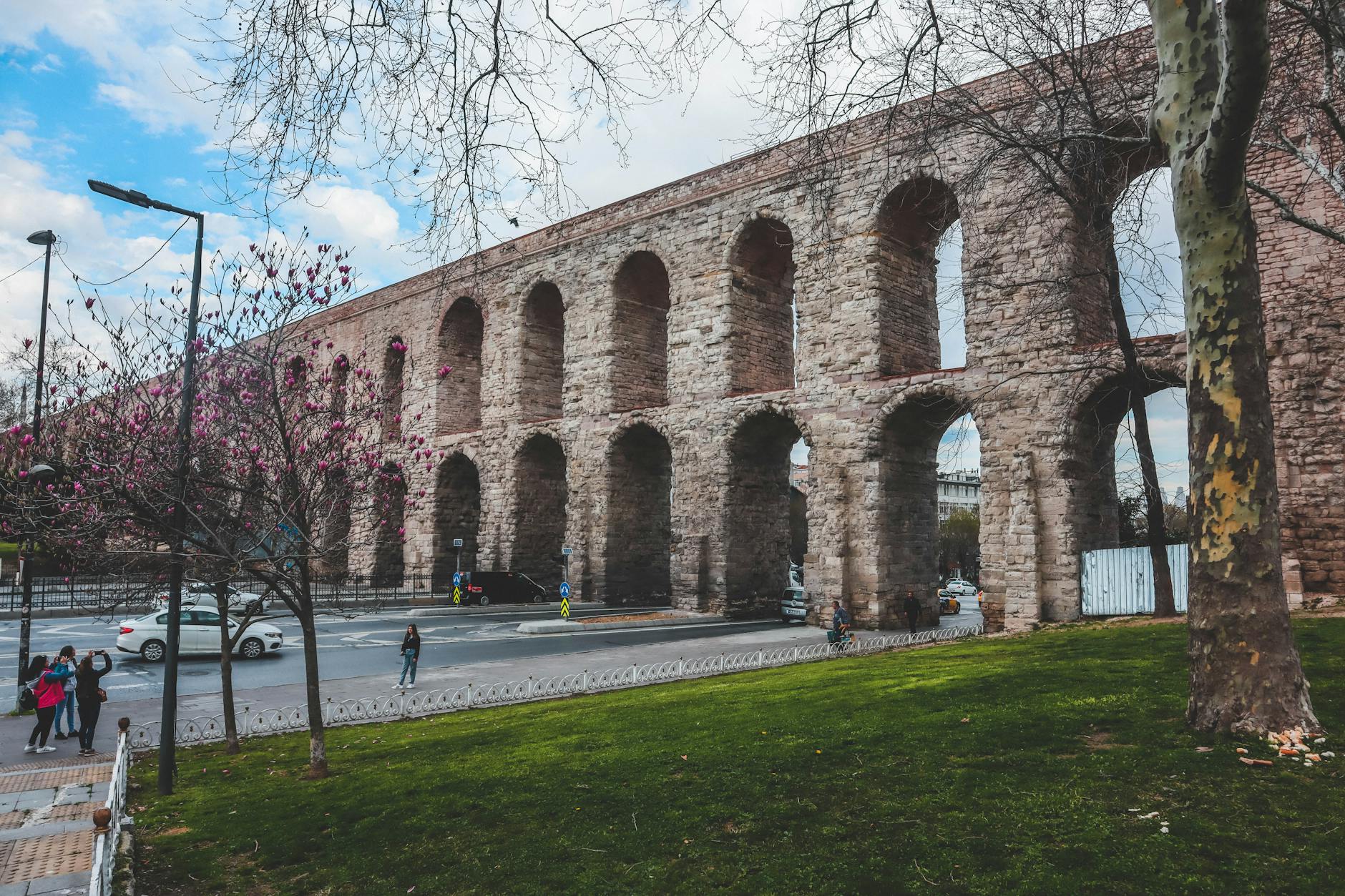
I remember my first week in Istanbul back in 2009. I was hopelessly lost in the labyrinthine streets of Fatih, clutching a paper map that was quickly becoming a casualty of the humid breeze. Just as I was about to give up and hail a taxi, I turned a corner and came face-to-face with a wall of stone so massive, so impossibly ancient, that it felt like the city had suddenly tilted on its axis.
Standing on the sidewalk of Atatürk Boulevard, watching the chaos of modern Istanbul traffic surge through the stone arches of a 1,600-year-old Roman aqueduct, remains my favorite way to feel the pulse of this city. It’s where the 4th century meets the morning commute, and even after 15 years of calling this place home, I still find it breathtaking. There is something profoundly humbling about watching a bright yellow Fiat Doblo or a packed municipal bus squeeze through a gateway built by the Emperor Valens’ stonemasons. While the rest of the world puts its Roman ruins in Istanbul behind velvet ropes and glass partitions, here, history is something we drive through on our way to buy groceries.
Known locally as the Bozdoğan Kemeri, or the “Aqueduct of the Grey Falcon,” this structure is more than just a relic of the Byzantine era. For a transport and infrastructure geek like me, it represents the very first heartbeat of the city’s survival. Without this 971-meter-long bridge bringing fresh water from the hills of Thrace to the Great Palace, the Constantinople we know today would never have flourished. It is the literal spine of the old city.
Most visitors catch a fleeting glimpse of the Valens Aqueduct from the window of a tour bus, a grey blur against the skyline. But if you want to experience the true soul of Istanbul, you have to step off the beaten path and linger in its shadow. You need to hear the call to prayer echoing off the weathered limestone and see how the sunlight hits the upper tiers during the “golden hour.”
Let me take you to my favorite vantage point—a spot where you can leave the crowds behind and see this architectural marvel exactly as it should be seen.
A Stone Sentinel in the Heart of Fatih: An Introduction to Bozdoğan Kemeri
There is a specific moment, usually around dusk in the late autumn of 2026, when the light hits the limestone of the Valens Aqueduct just right. The stones turn a deep, honeyed gold, and for a split second, the roar of the six-lane Atatürk Boulevard below seems to fade into a ghostly whisper of hoofbeats and chariot wheels.
When you first stand beneath these towering arches, the sensory experience is overwhelming. It’s a collision of worlds. You have the smell of közde kestane (chestnuts roasted over charcoal) wafting from a street vendor’s cart, the sharp tang of exhaust from the red municipal buses, and the rhythmic, melodic call to prayer echoing from the nearby Şehzade Mosque. Looking up, the scale of the structure—known locally as Bozdoğan Kemeri, or the “Arch of the Grey Falcon”—is staggering. It doesn’t just sit in the city; it anchors it.
My Fifteen-Year Love Affair with Fatih
I’ve lived in this city for fifteen years now, and for a good portion of that time, Fatih has been my backyard. I remember moving into my first apartment not far from here; I was a bit overwhelmed by the labyrinthine streets and the sheer “oldness” of everything. But the aqueduct became my North Star. No matter how lost I got in the backstreets of the malt (the neighborhood market area), I only had to look up to see that massive Istanbul skyline interrupted by Roman engineering to find my way home.
Fatih sightseeing can often feel like a marathon of history, but the aqueduct is different. It’s not tucked away behind a ticket booth or a turnstile. It is a living, breathing part of the commute. For me, it represents the grit and endurance of Istanbul. I’ve seen it weathered by snow, scorched by the intensifying Marmara summers, and survived through decades of urban transformation. Even now, with the 2026 exchange rates making a simple çay (Turkish tea) cost about 35 TL (less than a Euro at the current 50 TL rate), the view of the aqueduct remains one of the few priceless experiences left in this megalopolis.
A Bridge Across Time
What fascinates me most as a local expert is how the structure dominates the modern landscape. Originally completed in the 4th century by the Roman Emperor Valens, it once carried water from the hills of Thrace to the heart of the city. Today, it serves as a gateway. If you are using [public transport in Istanbul] to head from the Golden Horn toward the Marmara Sea, you will likely pass right through its soaring double-tiered arches.
It is a reminder that we are all just temporary guests in a city that has seen empires rise and fall like the tides of the Bosphorus. The way the modern asphalt curves to accommodate the ancient piers is a testament to Istanbul’s refusal to let go of its past.
Berk’s Insider Tip: While you can’t walk on top of the aqueduct for safety reasons, you can walk through the small park passages beneath it. It’s the only place where you can touch 4th-century Roman masonry while hearing the 21st-century sirens of Istanbul.
Whenever friends visit me, I always bring them here first. Not to the Hagia Sophia, and not to the Galata Tower, but here—where you can stand in the shadow of Rome and feel the pulse of a city that never stops moving. It is the most honest introduction to the “Real Istanbul” I can offer you.
Rome’s Lasting Legacy: The History and Purpose of the Valens Aqueduct
Whenever I’m walking through the Fatih district, I can’t help but run my hand along the weathered, pitted stones of the Valens Aqueduct—or as we locals call it, Bozdoğan Kemeri (the “Aqueduct of the Grey Falcon”). It’s 2026 now, and even with the roar of modern hybrid buses passing through its towering arches on Atatürk Boulevard, there is a heavy, humbling silence to these stones. They’ve been standing here since 368 AD, back when this city was the beating heart of the Roman world.
If you’re like me and have lived here for a while—it’s been 15 years for me now—you start to realize that Constantinople history isn’t just found in museums; it’s the literal infrastructure we drive under every day.
A Masterpiece Commissioned by Emperor Valens
The story of this massive structure begins with Emperor Valens. In the mid-4th century, the city was growing at a breakneck pace. It had the prestige, the palaces, and the people, but it had one massive problem: it was incredibly dry. Unlike Rome, which had a bounty of local springs, Constantinople was a peninsula surrounded by salt water but lacking in fresh drinking water.
To fix this, Valens initiated one of the most ambitious engineering projects of the ancient world. He didn’t just build a bridge; he created the final piece of a massive water network that stretched over 250 kilometers into the Thracian hills. When it was completed in 368 AD, it was a symbol of Roman dominance. I often tell my friends that if you want to see the best Roman ruins Istanbul has to offer, you start here. It wasn’t built just for aesthetics; it was built for survival.
The Strategic Importance of Water
You have to imagine the city back then. Without the water brought in by this aqueduct, the Great Palace, the massive public baths, and the hundreds of underground cisterns (like the famous Basilica Cistern) would have been empty shells. The aqueduct was the city’s jugular vein.
While this structure brought life into the city from the north, another massive project was protecting it from the land. Just as the aqueduct funneled water, the [Theodosian Walls] provided the physical security that allowed the city to thrive. Without both of these Roman marvels working in tandem, the Byzantine Empire likely wouldn’t have lasted a century, let alone a millennium.
A Survivor of Sieges and Shakes
What fascinates me most as a local is how this structure refused to fall. Istanbul is a city of earthquakes—we’ve had some “big ones” over the centuries, including the “Small Doomsday” of 1509. Yet, the Bozdoğan Kemeri remained. It also survived countless sieges. When enemies surrounded the city, the first thing they did was cut the aqueduct. But because the Romans and Byzantines were master planners, they used the aqueduct to fill massive underground reservoirs, allowing the city to hold out for months.
Here are a few reasons why this structure is an engineering miracle:
- Material Recycling: To build it, Valens actually reused stones from the walls of Chalcedon (modern-day Kadıköy).
- The Ottoman Touch: Even after the conquest in 1453, the Ottomans didn’t tear it down. Sultans like Berk the Conqueror and Suleiman the Magnificent repaired it, realizing that Roman engineering was too good to waste.
- The “Grey Falcon” Name: The Turkish name Bozdoğan likely refers to a family or a specific bird of prey, but to me, it signifies the structure’s soaring, predatory resilience over the city skyline.
Today, in 2026, you can sit at one of the small tea gardens nearby and watch the sunset hit the upper tiers. A glass of çay (Turkish tea) will only cost you about 25 TL (roughly 0.50 Euros), and a good Turkish coffee is around 75 TL (1.50 USD). It’s a small price to pay to sit in the shadow of 1,700 years of history. You aren’t just looking at a wall; you’re looking at the reason this city was able to become the “Queen of Cities.”
The Anatomy of Ancient Engineering: How the Aqueduct Still Stands
When you stand beneath the Bozdoğan Kemeri (the “Arch of the Grey Falcon”), as we locals call it, you aren’t just looking at a wall; you’re looking at a 1,600-year-old survivor. I’ve walked under these arches more times than I can count over the last 15 years, and every time, the sheer weight of the history—and the stone—hits me.
In 2026, with the city buzzing around us and the roar of traffic on Atatürk Boulevard, it’s easy to forget that this structure was the high-tech heart of Constantinople. To understand how it still stands, we have to look at the ancient engineering Istanbul relied on to keep its citizens hydrated and its empire thriving.
Recycled History: The Stones of Chalcedon
One of my favorite “insider” facts about the Valens Aqueduct is that it’s essentially a giant piece of upcycling. When Emperor Valens completed this in the late 4th century, his engineers didn’t just quarry new stone. They were practical—and perhaps a bit cheeky. They scavenged massive blocks from the walls of Chalcedon (modern-day Kadıköy on the Asian side).
The people of Chalcedon had sided with a usurper, and as punishment, their city walls were dismantled. Those stones were ferried across the Bosporus to build this very structure. When you run your hand over the lower sections, you’re touching stone that has seen the rise and fall of two different cities on two different continents. This Roman architectural habit of “spolia” (reusing old materials) wasn’t just about laziness; it was about speed and symbolic dominance.
The Double-Tiered Arch: Form Meets Function
You’ll notice that the aqueduct isn’t a solid wall, but a series of double-tiered arches. This design is a masterclass in Roman architecture. If the Romans had built a single, massive arch to reach the required height, the lateral pressure would have been too great for the soil to handle.
By stacking two levels of arches, the engineers distributed the weight vertically. The lower tier provides a wide, stable base, while the upper tier carries the actual water channel (the specus). It’s a rhythmic, skeletal design that allows the wind to pass through—crucial for a city that occasionally faces fierce Marmara storms—and gives the structure enough flexibility to survive the seismic tremors that have rattled Istanbul for centuries. Even today, as the 2026 metro lines hum deep underground nearby, the aqueduct barely flinches.
The Arteries of an Empire: The Water Network
The Valens Aqueduct wasn’t a standalone monument; it was the final leg of a massive Byzantine water system that stretched over 250 miles into the Thracian forests. Think of it as the main “fiber-optic cable” for water. Once the water crossed these arches, it didn’t just stop. It was gravity-fed into a sophisticated network of pressurized pipes and massive subterranean reservoirs.
The water would flow from here into grand storage spaces like the [Theodosius Cistern], where it was kept cool and protected from siege or poisoning. From those cisterns, it was distributed to the Great Palace, the public baths (hamams), and the fountains where ordinary citizens gathered.
To give you an idea of the scale and the “2026 reality” of visiting these sites, here is a quick breakdown of what you can expect when exploring this specific part of the ancient water map:
| Feature | Valens Aqueduct (Bozdoğan) | Typical Byzantine Cistern |
|---|---|---|
| Access | Free (Public Landmark) | 450 - 900 TL (Approx. $10 - $20) |
| Best Time | Sunset for the golden glow | Midday to escape the heat |
| Primary Material | Limestone and Scavenged Marble | Brick, Mortar, and Waterproof Plaster |
| Function | Transport (The “Pipe”) | Storage (The “Tank”) |
| 2026 Vibe | Busy urban park atmosphere | Quiet, reflective, and cool |
Note: In 2026, expect a decent cup of Turkish tea at the nearby cafes to run you about 50 TL (€1), a small price to pay for the best view of Roman gravity at work.
The structural integrity of these arches is so sound that even after the Ottomans took the city in 1453, Sinan—the greatest architect of the Ottoman Empire—simply repaired and integrated it into his own new water systems. It wasn’t broken, so he didn’t fix it; he just made it better. That’s the true legacy of the Valens: a piece of engineering so perfect that every subsequent civilization simply decided to keep using it.
Berk’s Favorite Perspectives: Where to Get the Best View
After fifteen years of wandering these backstreets, I’ve learned that the Bozdoğan Kemeri (the Valens Aqueduct) isn’t just a monument you look at; it’s one you experience through the layers of the city. Depending on where you stand, it shifts from a Roman relic to a living part of a bustling 2026 neighborhood. If you want more than just a passing glance from a tour bus, here are the spots where I always take my friends when they visit.
Fatih Parkı: The Classic Urban Oasis
Whenever I need a moment of zen, I head to Fatih Parkı (Fatih Park), right next to the Fatih Memorial. It’s one of the few places where you can truly appreciate the sheer scale of the arches while surrounded by greenery. Local families often gather here, and in the late afternoon, the sound of children playing creates a beautiful contrast against the 1,600-year-old stone.
The park allows you to walk right up to the base of the structure. From here, you can see the different types of stone used in various repairs over the centuries—a literal timeline of Istanbul’s survival. It’s one of the premier Istanbul photography spots because you can frame the arches with the surrounding trees.
Berk’s Insider Tip: For the most dramatic photos without the crowds, arrive at Fatih Parki just as the sun begins to set; the light hits the upper arches of the Bozdoğan Kemeri perfectly, turning the stone a deep honey gold.
Vefa’s Rooftops: A Hidden World Above the Streets
Just a short walk from the main stretch of the aqueduct lies the Vefa neighborhood. This is one of Istanbul’s most traditional quarters, famous for its historic boza shop (a fermented grain drink you must try if you’re here in winter). But the real secret of Vefa lies above the street level.
The area is dotted with small, unassuming rooftop cafes. These aren’t the high-end, “white tablecloth” spots you’ll find in Beyoğlu; these are local haunts where a çay (tea) will cost you about 40 or 50 TL—roughly 1 Euro at today’s 2026 rates. From these heights, you get an eye-level view of the aqueduct’s upper tiers.
While you’re exploring the rooftops of this area, you’ll notice how the aqueduct seems to point you toward other architectural giants. If you look toward the Third Hill, you can clearly see the dome of the [Suleymaniye Mosque], which is just a ten-minute walk away and offers a whole different perspective on the city’s skyline. Seeing the Roman arches and the Ottoman minarets in a single frame is, for me, the quintessential Vefa neighborhood experience.
The Atatürk Boulevard Underpass: Drama in Motion
For something entirely different, I always recommend the “underpass view” on Atatürk Boulevard. This is where my transport nerd side really comes out. Standing on the sidewalk as the heavy city traffic flows through the massive Roman arches is exhilarating.
The contrast is striking: 2026 hybrid buses and electric taxis zooming through gates that were built before the concept of an engine even existed. To get the best Bozdogan Kemeri views here, stand on the pedestrian walkway on the north side of the boulevard. If you’re into long-exposure photography, this is the place to be at twilight. The streaks of headlights passing through the ancient stone “tunnels” create a sense of time travel that you won’t find anywhere else in the city. It’s loud, it’s busy, and it’s perfectly Istanbul.
A Walk Through Vefa: More Than Just Ancient Stone
Once you’ve finished marveling at the scale of the Valens Aqueduct, I want you to do something most tourists forget: turn your back to the heavy traffic of Atatürk Boulevard and step into the winding side streets of Vefa. If the aqueduct is the sturdy backbone of this area, Vefa is its beating, weathered heart. For me, after 15 years of living here, this neighborhood remains one of the few places where you can still breathe in the “old soul” of the city.
The Whispering Walls of Ahşap Evler
As you begin your Old City walking tour through these backstreets, the first thing you’ll notice is the architecture. Vefa is famous for its dwindling collection of ahşap evler—traditional Ottoman wooden houses. Some have been beautifully restored to their former glory, painted in ochre and deep reds, while others lean tiredly against one another, their silvered timber tell-tale signs of a century of Istanbul humidity.
In 2026, as the city continues to modernize at a breakneck pace, these homes are precious. Look up and you’ll see the cumba—the classic bay windows that allowed Ottoman residents to watch the street life below without being seen. Even with the current exchange rates (where a simple tea in a local spot might cost you 25 TL, or about 0.50 Euro), the atmosphere here remains priceless. There is a quiet dignity in these streets that you won’t find in the glass-and-steel districts of Levent or Maslak.
Where Rome Meets the Ottomans
What fascinates me most about this corner of the Fatih district guide is the seamless transition between eras. One moment you are standing in the shadow of a Roman monument built in the 4th century, and the next, you are passing under the gate of an Ottoman-era madrasah (theological school). The Romans gave the city its infrastructure, but the Ottomans gave it its domestic intimacy.
Walking through Vefa Istanbul feels like a lesson in layering. You’ll see fragments of Byzantine brickwork repurposed into the foundations of 18th-century stone fountains. It’s not a polished museum experience; it’s messy and lived-in. You’ll see laundry strung between a Roman-era pillar and a modern balcony, or a local shopkeeper weighing out spices in a building that has stood through three different empires.
Why This Feels Like ‘Real’ Istanbul
People often ask me where they can find the “real” Istanbul. My answer is always Vefa. It’s “real” because it doesn’t try to sell itself to you. There are no neon signs or touts trying to pull you into carpet shops. Instead, you’ll hear the clinking of tea spoons from a local coffeehouse and the call to prayer echoing off the ancient stones.
It’s the kind of place where neighbors still know each other’s names. When I’m craving a meal that tastes like it was made in a family kitchen, I usually stop by a local [esnaf lokantası] for a bowl of lentil soup or some slow-cooked eggplant. These “tradesmen restaurants” are the social glue of the neighborhood, offering honest food at honest prices—usually around 200 to 350 TL (roughly 4 to 7 USD) for a hearty, multi-course lunch in today’s 2026 economy.
Berk’s Insider Tip: Don’t just look at the stones; head to the nearby Vefa Bozacısı. It’s a legendary shop serving ‘Boza’, a fermented grain drink that has been a local staple since the Ottoman era—it’s the perfect companion for an afternoon of Roman history.
Practical Tips: How to Reach the Aqueduct Like a Local
Getting around our sprawling metropolis has changed quite a bit since I first moved here 15 years ago, but in 2026, the transport network is more efficient than ever. While many tourists get stuck in the Sultanahmet bubble, reaching the Valens Aqueduct—or Bozdoğan Kemeri (meaning “Arch of the Grey Falcon”) as we locals call it—is actually a breeze if you know the right shortcuts.
Here is my step-by-step guide to navigating the city like a pro to reach this Roman masterpiece.
1. The Efficient Route: Using the M2 Metro
If you want to avoid the notorious Istanbul traffic, the Vezneciler metro stop is your best friend. This station is on the M2 (Green) line, which connects the modern hubs of Levent and Maslak to the old city.
- The Action: Take the M2 line towards Yenikapı and get off at Vezneciler-İstanbul Üniversitesi.
- The Walk: Once you exit, follow the signs for the “16 Mart Şehitleri” exit. From here, it’s a gentle 10-minute stroll heading west along Şehzadebaşı Caddesi. You’ll pass the stunning Şehzade Mosque on your right—don’t forget to look up!
- Cost: A single ride on your Istanbulkart will currently set you back about 40 TL (just under 1 USD at our current 45 TL exchange rate). It’s the fastest way to master Istanbul transport tips.
2. The Scenic Route: Buses from Taksim or Eminönü
For those who prefer to keep their eyes on the city streets, the bus system remains the backbone of Fatih.
- From Taksim: Look for buses heading towards Aksaray or Fatih (Lines like the 87 or 76T are reliable). You want to get off at the İstanbul Büyükşehir Belediyesi (Istanbul Metropolitan Municipality) stop.
- From Eminönü: Head to the bus platforms near the ferry terminals. Almost any bus heading up the hill toward Fatih (like the 38E or 37E) will pass under the arches.
- The Experience: There is something truly magical about sitting on the top deck of a bus as it drives directly through the arches of the aqueduct. It’s one of those “only in Istanbul” moments that still gives me goosebumps after 15 years.
3. The “Deep Istanbul” Experience: The Zeyrek Walk
If you really want to earn your dinner, I recommend combining your visit with a trip to the Zeyrek Mosque (the former Monastery of the Pantokrator). This is where you’ll find the “discerning traveler” crowd I mentioned.
- The Path: Start at the Valens Aqueduct and walk north toward the Golden Horn. It’s a 10-minute walk through the winding, cobblestone streets of the Zeyrek neighborhood, filled with Ottoman-era wooden houses.
- Why it matters: Zeyrek is a UNESCO World Heritage site and offers a view of the aqueduct that most tourists never see. Standing by the mosque, you can see the Roman arches cutting through the valley of the city’s fourth hill.
4. Navigating Like a Local in 2026
Before you set off, make sure your Istanbulkart is topped up. In 2026, we’ve moved largely to digital payments, but the physical card is still a great souvenir. With the Euro at 50 TL, your transport costs are incredibly low—usually less than 0.80 Euro per trip. If you get turned around, just ask a local for the “Kemer” (the arch); we’re a friendly bunch and always happy to point a traveler toward our city’s history.
Remember, the area around the aqueduct is a living neighborhood. Grab a simit (a circular bread encrusted with sesame seeds) from a street vendor for 20 TL, find a bench in the park beneath the arches, and just watch the city go by. That is how you truly experience Istanbul.
Preservation and the Modern City: Why Bozdoğan Kemeri Matters Today
There is a specific kind of magic that happens when you sit at a café in Fatih, sipping a çay (tea) and watching the relentless 2026 traffic flow through the arches of the Valens Aqueduct. To the uninitiated, it’s a bottleneck on Atatürk Boulevard; to those of us who have called this city home for years, it is the very spine of Istanbul. After fifteen years here, I’ve realized that Istanbul heritage isn’t something kept behind velvet ropes—it’s something we drive under, live beside, and lean against while waiting for the bus.
The Gentle Hands of Restoration
In this year of 2026, we are seeing a renewed vigor in Roman monument preservation. The Belediye (Metropolitan Municipality) has been working tirelessly on a multi-phase restoration project to stabilize the masonry that has weathered seventeen centuries of earthquakes and humidity. It is a delicate dance. How do you reinforce a structure that was built when Constantine the Great’s successors were still settling into their thrones?
The current efforts focus on “breathable” lime-based mortars, replacing the heavy-handed cement repairs of the mid-20th century that actually trapped moisture and hurt the stone. Even with the current economy—where a Euro will set you back 50 TL and a USD is hovering at 45 TL—the city has prioritized this budget. It’s an expensive endeavor, but as any local will tell you, the Bozdoğan Kemeri (the “Aqueduct of the Grey Falcon”) is non-negotiable. It is the physical manifestation of our endurance.
A Backdrop for the Turkish Soul
If you want to understand the place this monument holds in Turkish culture, look no further than our cinema and literature. In the golden age of Yeşilçam (the Turkish Hollywood) during the 60s and 70s, the aqueduct was the ultimate visual shorthand for “arrival.” When a protagonist migrated from a rural Anatolian village to the “Gold-Paved” city of Istanbul, the camera almost always caught them staring up at these arches. It represented the scale of their dreams and the crushing weight of the city’s history.
Even today, poets write of the aqueduct as a bridge between the Roman ghost and the modern Turk. It appears in the melancholic novels of Orhan Pamuk and the haunting verses of Yahya Kemal Beyatlı. To us, it isn’t just a “Roman ruin”; it is a silent character in the story of our lives. It symbolizes the bridge between the water-bringers of the past and the digital nomads of today.
Living Alongside History: A 15-Year Reflection
People often ask me why I stayed in Istanbul for fifteen years. My answer usually involves a sunset view of these very arches. There is something deeply grounding about living in a city where the “temporary” nature of our modern problems is put into perspective by 1,600-year-old stone.
When I first moved here, I used to see the aqueduct as a curiosity. Now, I see it as a roommate. I’ve seen it through snowstorms, through political shifts, and through the changing face of the neighborhood. It reminds me that while the Lira may fluctuate and the city may grow more crowded, the foundation of this place is rock solid. Living alongside such history forces you to be a bit more philosophical. You realize that we are just the current stewards of these streets. We don’t own Istanbul; we simply look after it for a while.
The next time you’re heading toward the Golden Horn, take a moment. Don’t just look at the aqueduct through a lens. Feel the temperature change as you pass through its shadow. That coolness you feel? That’s the breath of the ancient world, still exhaling in the heart of our 21st-century chaos.
Conclusion
Standing directly beneath those massive limestone arches, you really feel the weight of sixteen centuries pressing down—not in a heavy way, but in a way that makes your own daily worries feel wonderfully small. There is a specific thrill in watching the chaotic, modern traffic of Atatürk Boulevard surge through the gaps of a 4th-century Roman masterpiece. It’s the quintessential Istanbul moment: the ancient world isn’t tucked away behind a velvet rope; it’s literally supporting the commute of a thousand honking taxis.
My personal verdict? You haven’t truly “seen” Istanbul until you’ve stopped moving and let the city rotate around you at this spot. To do it right, I want you to walk just a few blocks over to the historic Vefa Bozacısı. Grab a glass of boza—that thick, fermented grain drink—topped with plenty of cinnamon and roasted chickpeas. If it’s a warmer day, a simple, steaming çay from any of the plastic-stool cafes nearby will do just fine.
Sit there, lean back, and just watch. Notice how the locals barely glance up at the aqueduct as they rush to the Fatih Mosque or the metro; then notice how the evening sun catches the weathered stone, turning it a pale, dusty gold. It is a reminder that while empires crumble and water stops flowing, the spirit of this city remains stubbornly, beautifully alive.
Berk’s Local Tip: Don’t just view the aqueduct from the street level. Head up to the terrace of one of the modest “hidden” cafes in the Zeyrek neighborhood nearby. You’ll get a bird’s-eye view of the arches stretching toward the Marmara Sea, framed by the minarets of the city skyline. It’s a perspective most tourists miss, and it’s where I go when I need to fall in love with this city all over again.
See you out there on the cobblestones,
Berk
Comments
Share your thoughts with us