
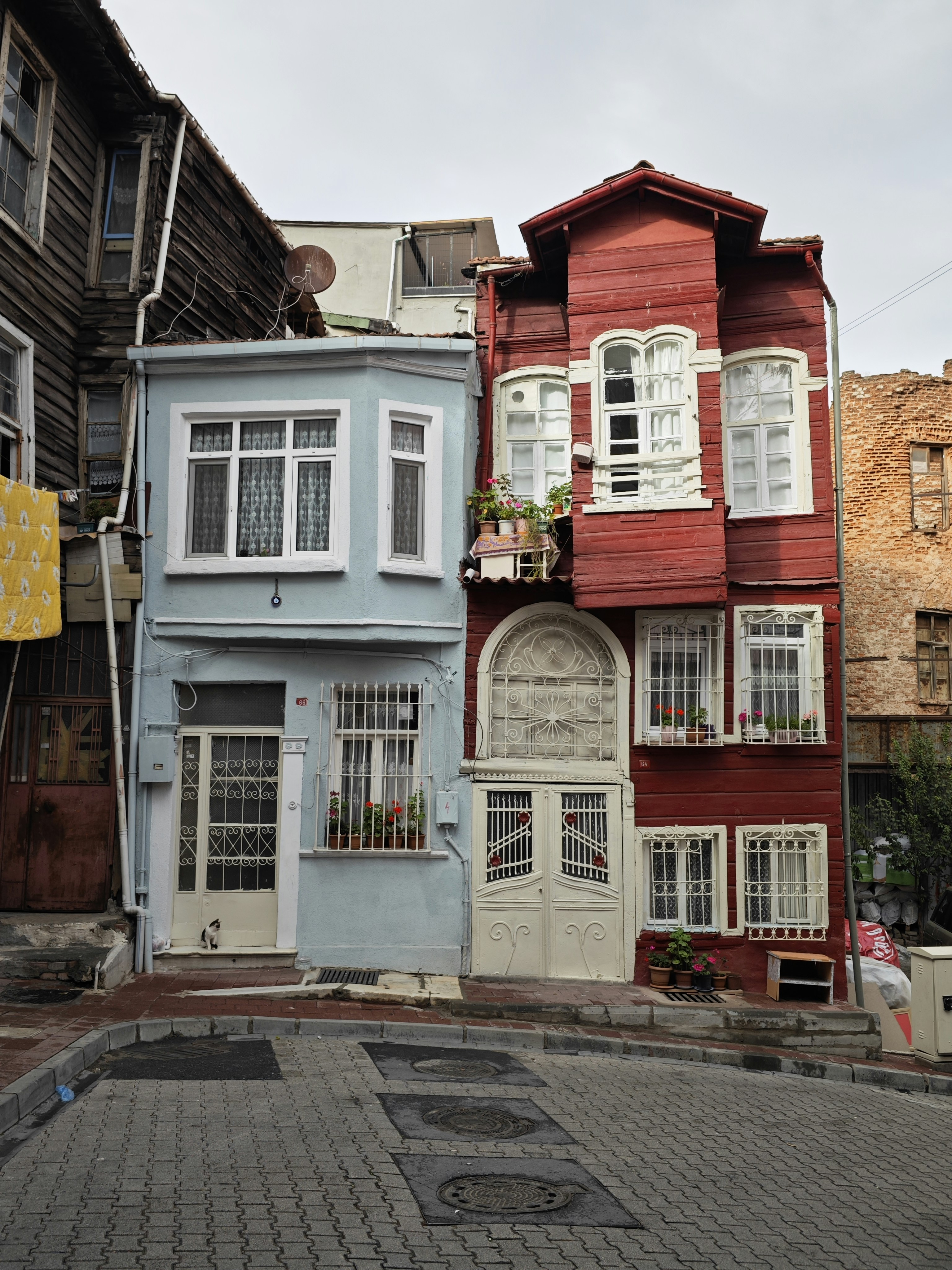
There is a specific hour in Fener — somewhere between 9:30 and 10:30 on a Tuesday morning — when the neighbourhood belongs entirely to itself. The breakfast cafe owners are arranging their outdoor chairs, a cat is asleep on a Byzantine column base that’s been repurposed as a doorstep, and the morning light is hitting the Easter-egg houses of Vodina Caddesi at an angle so flattering it looks like a film set. By noon, tour groups will arrive and Instagram will claim it. But for that one hour, it is just Istanbul doing what it has done for fifteen hundred years: quietly getting on with things.
I’ve been walking these streets for fifteen years, and Fener-Balat remains my honest answer when visitors ask where to find the city that hasn’t been packaged for tourists. It’s not a theme park version of old Istanbul — it’s a real, functioning, slightly worn-at-the-edges neighbourhood where you are genuinely visiting someone else’s life for a morning.
What Are Fener and Balat?
These are two adjoining neighbourhoods on the western shore of the Golden Horn, the inlet that splits European Istanbul from its own historic heart. Administratively both fall within the Fatih district, and geographically they sit between Eminönü to the east and Eyüp to the west.
The names reflect their distinct identities:
- Fener (meaning “lighthouse” in Turkish) was historically the centre of the Greek Orthodox community in Ottoman Istanbul. The Ecumenical Patriarchate — the spiritual headquarters of Eastern Orthodox Christianity — is still here, and the red-brick Greek Orthodox school on the hill remains one of the most striking buildings in the city.
- Balat was the heart of Istanbul’s Jewish community for centuries, and traces of that heritage remain in the street layout, the synagogues, and the older residents who can still point to which building was what.
Together they represent the kind of layered, multi-faith urban history that makes Istanbul uniquely extraordinary — a place where Byzantine walls, Ottoman architecture, and Sephardic Jewish heritage occupy the same block.
The Colourful Houses: What You’ve Seen on Instagram
The brightly painted houses of Balat — sky blue, coral pink, mustard yellow, mint green — are the most photographed thing in the neighbourhood, and with good reason. They are genuinely beautiful.
What most people don’t know: the vivid colours are actually relatively recent. The houses were repainted as part of a municipal restoration project in the 2000s and 2010s. Many of the buildings themselves date from the 19th century, and some are significantly older, but the rainbow palette is a conscious preservation choice rather than an ancient tradition.
The main strip for colourful houses is Vodina Caddesi and the lanes running uphill from it. The steep alley of Merdivenli Yokuş is particularly atmospheric.
Berk’s Insider Tip: For the best photos, arrive before 10 AM on a weekday. Walk up to the top of the hill first and shoot downward — the light comes from the east and hits the facades beautifully in the morning. By noon the shadows flatten everything out.
What to See: The Walking Route
Start: Balat Ferry Stop / Golden Horn Shore
If you’re coming by T5 tram, start at the waterfront and walk uphill. The Golden Horn here has been cleaned up significantly over the past two decades — it was heavily polluted for most of the 20th century and now has a pleasant promenade.
Walking time from here to the top of Fener: about 45 minutes at a gentle pace, not including stops.
Sveti Stefan — The Bulgarian Iron Church
About five minutes’ walk from the Balat tram stop, right on the shoreline, is one of the most extraordinary buildings in Istanbul: the Church of St Stephen of the Bulgars, locally known as the Bulgarian Iron Church.
Built in 1898, the entire structure — walls, columns, arches, and decorative elements — is made of cast iron, prefabricated in Vienna and shipped down the Danube. Tap the wall and it rings like a bell. It looks like a neo-Gothic stone cathedral, but it is hollow metal. The interior, recently restored, is exquisite.
Entry is free. Open Tuesday to Sunday.
Balat’s Streets: Vodina Caddesi and Beyond
The main commercial street of Balat is Vodina Caddesi, lined with breakfast cafes, antique shops, small galleries, and the odd elderly resident who looks rightly suspicious of all the people photographing their front door.
The lanes branching uphill from Vodina are where the real character lives. Get deliberately lost. You’ll find:
- 19th-century wooden yalı-style houses listing gently to one side
- Cats — hundreds of them
- Small courtyards that might be a cafe or might be someone’s garden (sometimes both)
- Ancient Byzantine wall fragments repurposed as garden boundaries
Breakfast in Balat
Balat has built a well-deserved reputation for breakfast. Several cafes serve elaborate serpme kahvaltı spreads with dozens of small dishes — olives, cheeses, eggs cooked various ways, honey, clotted cream, tomatoes, cucumbers, cold cuts.
2026 prices: 400–650 TL per person for a full spread, including unlimited tea.
Queues are common on weekends. Arrive before 10 AM or after 2 PM to avoid the worst of it.
The Ecumenical Patriarchate — Fener
Walking uphill from Balat into Fener, you’ll reach the compound of the Ecumenical Patriarchate of Constantinople, the spiritual centre of the world’s Eastern Orthodox Christians. The Patriarch of Constantinople — currently a figure with global religious significance — lives and works here, in a modest set of buildings behind a gate on a fairly unremarkable side street.
The Church of St George within the compound is open to visitors. The interior contains extraordinary religious artefacts including the throne of the patriarch and a reliquary said to contain the remains of St Gregory the Theologian.
Entry: Free. Modest dress required.
The Red School (Fener Rum Lisesi)
Dominating the Fener skyline is the enormous red-brick building known locally as the Kırmızı Bina (Red Building) — officially the Fener Greek Boys’ High School (Fener Rum Lisesi). Built in 1881 in an imposing neo-Gothic style, it was once the most prestigious Greek Orthodox secondary school in the Ottoman Empire.
Today the school is still operating, though with dramatically fewer students than its peak. It is not open to casual visitors but the exterior is worth the walk uphill for the view back over the Golden Horn.
Practical Information for 2026
Getting there:
- T5 tram from Eminönü to Fener or Balat stop (about 15 minutes, ~35 TL)
- Taxi from Sultanahmet: ~150-200 TL, 10-15 minutes
- On foot from Eminönü: About 35-40 minutes along the Golden Horn promenade — very pleasant on a clear day
Best time to visit: Tuesday to Friday, 9-11 AM
Avoid: Saturday and Sunday afternoons (very crowded)
What to bring:
- Comfortable shoes — the streets are steep and cobblestoned
- Cash — many small cafes and shops are cash only
- A modest layer if visiting religious sites
How long to spend: Half a day is ideal. A rushed visit is 2 hours; a proper explore with breakfast is 4-5 hours.